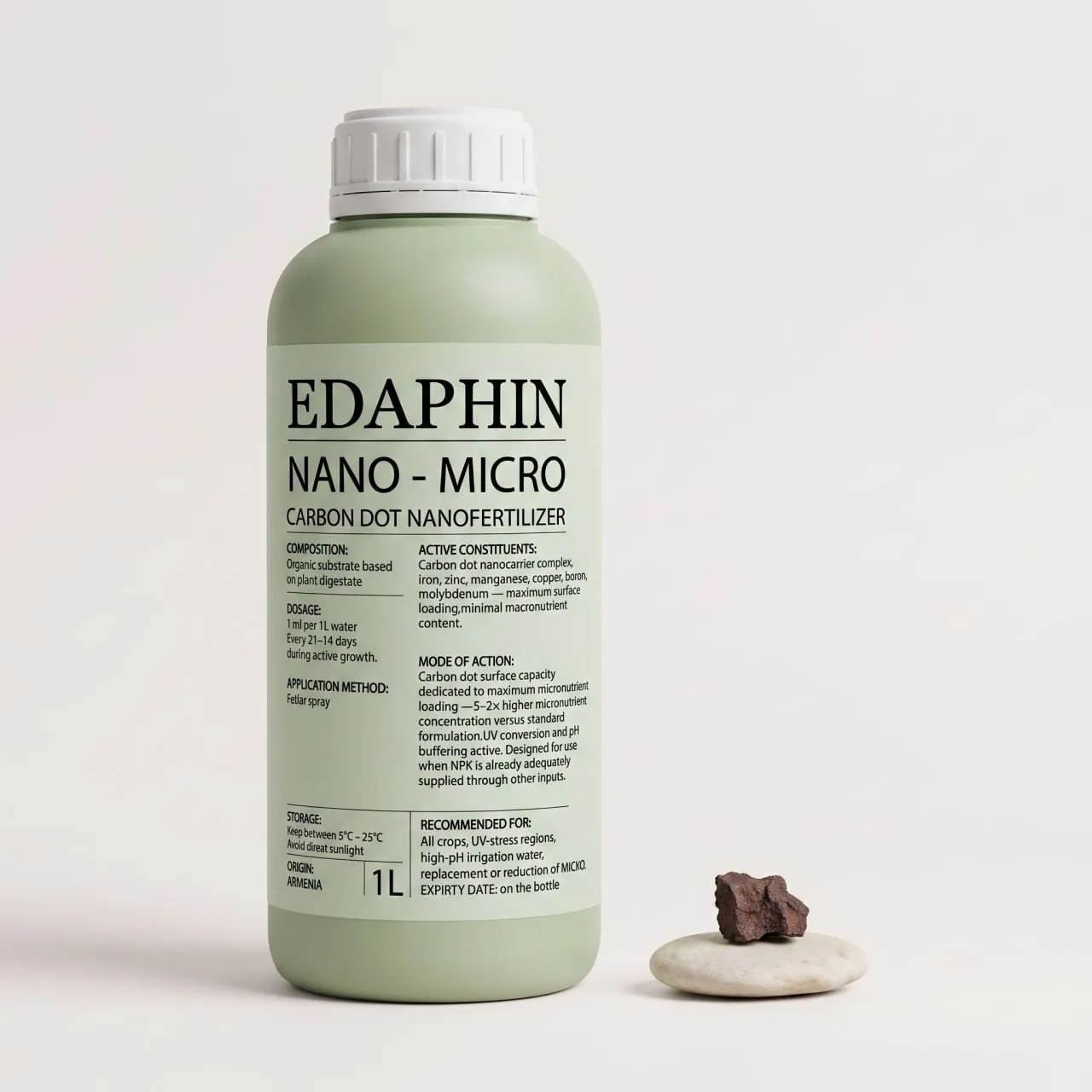
EDAPHIN NANO — MICRO
Precision Micronutrient Guardian — Maximum Concentration, Zero Macros
"For when the plant needs micronutrients. Not more nitrogen."
EDAPHIN Nano Micro is the specialized micronutrient formulation in the EDAPHIN Nano line — engineered for maximum micronutrient loading on the carbon dot carrier, with macronutrient (NPK) content reduced to the minimum required for synthesis integrity. Designed for situations where nitrogen, phosphorus, and potassium are adequately supplied through other inputs, and the limiting factor is specifically micronutrient availability.
When to Use EDAPHIN Nano Micro
- The crop is already receiving adequate NPK through soil application or fertigation, and adding more nitrogen or phosphorus would be counterproductive
- Micronutrient deficiency has been diagnosed through soil or leaf tissue analysis and targeted correction is required
- The production system requires precise nutrient management — organic transition farms, high-value specialty crops, precision agriculture operations
- A complementary micronutrient product is needed alongside EDAPHIN Nano NPK in a rotation program
How It Works
The same carbon dot platform, UV conversion capability, and pH-buffering mechanism operate as in the other EDAPHIN Nano formulations. The key difference is formulation design: micronutrient loading on the carbon dot surface is maximized by reducing macronutrient competition for surface binding sites.
In EDAPHIN Nano Plus, NPK and micronutrients share the available surface functional groups on the carbon dot. In EDAPHIN Nano Micro, the majority of surface capacity is dedicated to micronutrient complexation — resulting in 2–5× higher micronutrient concentrations per liter of product while maintaining the same application rate and spray volume.
Composition
| Component | Content |
| Total Nitrogen (N) | 3.7% w/v |
| Soluble Phosphorus (P₂O₅) | 0.2% w/v |
| Soluble Potassium (K₂O) | 0.5% w/v |
| Organic Carbon (OC) | 10.1% w/v |
| Iron (Fe) | 1.872% w/v |
| Zinc (Zn) | 1.102% w/v |
| Manganese (Mn) | 0.965% w/v |
| Copper (Cu) | 0.173% w/v |
| Boron (B) | 0.269% w/v |
| Molybdenum (Mo) | 0.040% w/v |
| pH (concentrate) | ~3.6 |
| Density | 1.20 g/cm³ |
Application Guidelines
Standard Foliar Application
- Dilution: 1:8,000 (same as other EDAPHIN Nano formulations)
- Frequency: Every 14–21 days for maintenance; every 10–14 days for active deficiency correction
- Timing: Early morning or late afternoon
Rotation Protocol (Recommended)
For comprehensive nutrition programs, EDAPHIN Nano Micro can be alternated with EDAPHIN Nano NPK on a bi-weekly rotation:
- Week 1 & 3: EDAPHIN Nano NPK — macronutrient supply + UV protection
- Week 2 & 4: EDAPHIN Nano Micro — micronutrient correction + UV protection
This rotation delivers complete nutritional coverage while maintaining optimal pH and UV protection throughout the growing season.
Comparative Micronutrient Loading
| Micronutrient | EDAPHIN Nano Plus | EDAPHIN Nano Micro |
| Iron (Fe) | 0.740% | 1.872% (2.5×) |
| Zinc (Zn) | 0.456% | 1.102% (2.4×) |
| Manganese (Mn) | 0.344% | 0.965% (2.8×) |
| Copper (Cu) | 0.056% | 0.173% (3.1×) |
| Boron (B) | 0.070% | 0.269% (3.8×) |
| Molybdenum (Mo) | 0.013% | 0.040% (3.1×) |
Environmental Profile — All EDAPHIN Nano Formulations
All three EDAPHIN Nano products share the same environmental commitment:Zero microplastic residue: No polymer capsules. No synthetic coating materials. Carbon dot carriers are organic, biodegradable nanoparticles that degrade through oxidative pathways in soil and plant tissue. 60-day monitoring studies show particle levels in plant tissue decrease to near-zero following application.
Reduced synthetic chemical input: Field trials demonstrate that EDAPHIN Nano formulations allow farmers to achieve equal or superior yields with reduced conventional chemical fertilizer inputs — lowering nitrogen runoff, phosphorus fixation losses, and greenhouse gas emissions.
Reduced acid chemical use: The pH buffering capability of EDAPHIN Nano formulations reduces or eliminates the need for sulfuric or nitric acid dosing in greenhouse irrigation systems.
SDG alignment: EDAPHIN Nano contributes to UN Sustainable Development Goals 2.4, 3.9, 12.4, and 13.
Safety and Regulatory Status
Carbon dot nanomaterials derived from organic precursors have been evaluated in multiple peer-reviewed studies for cytotoxicity in plant cells, bacterial cultures, fish, and mammalian cells. At agronomically relevant concentrations, organic carbon dots demonstrate biocompatibility and low toxicity profiles.
EDAPHIN Nano products are registered with the relevant agricultural authorities in Armenia. Regulatory submissions for EAC certification (Russia and EAEU markets) are in progress. EU regulatory pathway is under evaluation.
Note: As a novel nanomaterial category, long-term multi-year soil accumulation studies under continuous commercial use are ongoing. ICCI Group is committed to transparent reporting of all field monitoring data as it becomes available.