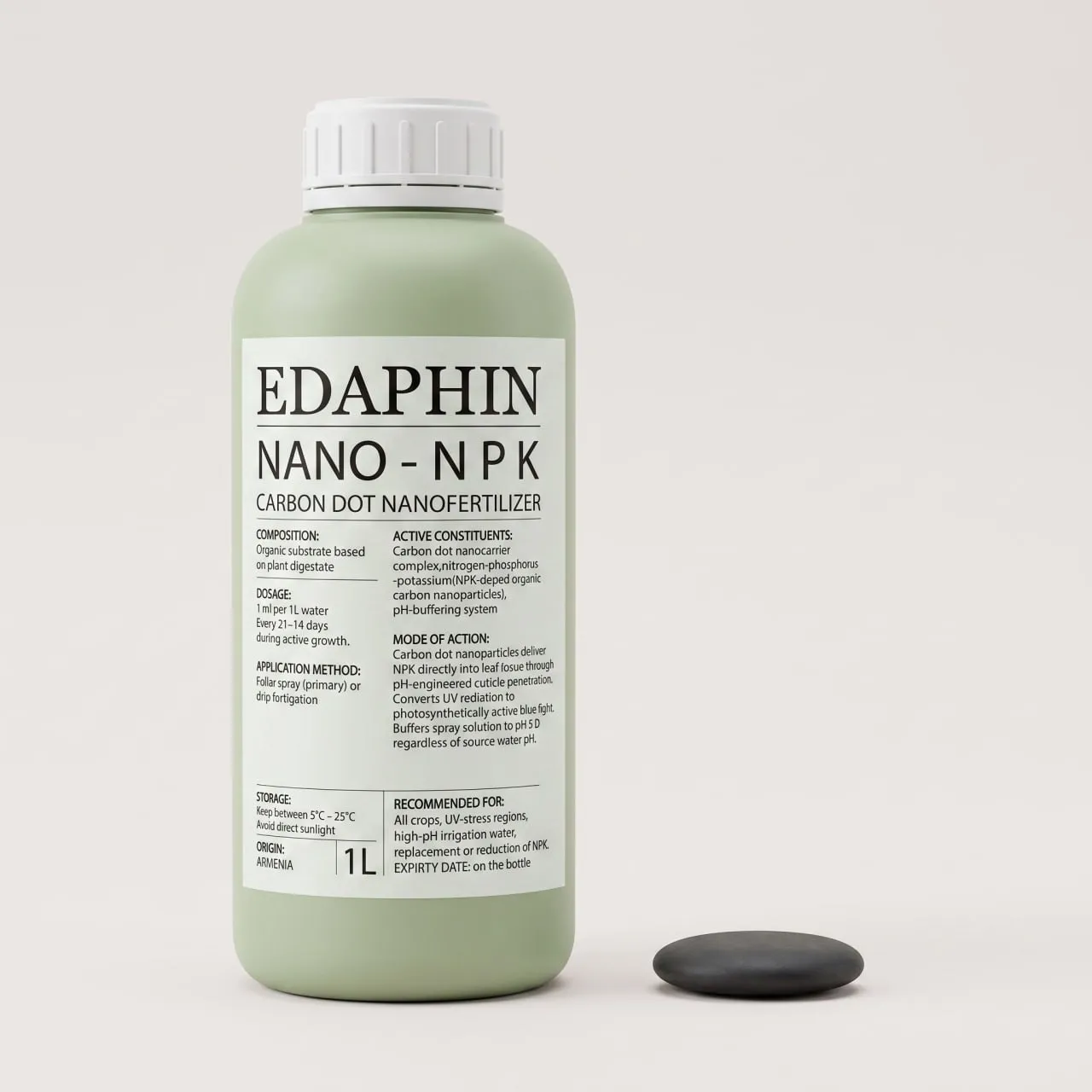
EDAPHIN NANO — NPK
The Guardian Fertilizer — Engineered for Maximum Absorption
"One liquid application. Three simultaneous actions. Zero plastic residue."
EDAPHIN Nano NPK is a carbon dot-based liquid nanofertilizer that simultaneously delivers nitrogen, phosphorus, and potassium to crops while protecting against UV radiation damage and optimizing foliar absorption through pH engineering. Unlike conventional fertilizers that rely on passive soil chemistry, EDAPHIN Nano NPK works at the nanoscale — where particles are small enough to enter plant tissue directly, deliver nutrients precisely, and convert harmful UV radiation into photosynthetically useful light.
The Problem It Solves
UV Radiation Damage: Increasing UV intensity due to climate change burns leaves, degrades foliar spray solutions before absorption, and reduces photosynthetic efficiency. Farmers in high-altitude regions such as the Armenian Highlands and arid zones across the Gulf region experience crop losses every summer from UV-induced leaf damage.
Poor Foliar Absorption: Most foliar sprays are applied with alkaline or neutral water (pH 7.5–8.5). At this pH, the spray solution cannot penetrate the leaf cuticle — the waxy protective layer covering the leaf surface. The solution sits on the leaf surface and evaporates before nutrients enter the plant. Research shows that less than 15% of phosphorus applied through conventional foliar sprays reaches plant tissue under alkaline conditions.
Microplastic Contamination: Polymer-coated slow-release fertilizers leave plastic residue in the soil with every application. Microplastics from agricultural sources have now been detected in human blood (9 in 10 adults tested, Scientific Reports 2024), in marine organisms, and in food crops. EDAPHIN Nano NPK contains zero polymer capsules and leaves zero microplastic residue.
How It Works
EDAPHIN Nano NPK is built on carbon dots — spherical carbon nanoparticles approximately 10 nanometers in diameter. These particles are functionalized with nitrogen, phosphorus, and potassium through a proprietary synthesis process, creating a stable nanocarrier system that delivers nutrients directly into plant tissue.
Mechanism 1 — UV Conversion and Protection
Carbon dots absorb UV radiation (300–400 nm) and convert it to blue light (420 nm) — the wavelength most efficiently used by chlorophyll for photosynthesis. This conversion happens on two levels:
- On the leaf surface: Carbon dots remaining on the spray-covered leaf surface absorb UV radiation, protecting nutrients in the spray solution from UV degradation and extending the window for cuticle penetration before the solution dries.
- Inside the leaf tissue: Carbon dots that have penetrated the cuticle continue to convert UV to blue light from within the mesophyll layer, directly supplying photosynthetically active radiation to chloroplasts.
Mechanism 2 — pH-Engineered Cuticle Penetration
EDAPHIN Nano NPK buffers spray solution to pH 5.0 — the scientifically validated optimum for foliar absorption. At this pH:
- The spray solution penetrates the leaf cuticle directly, reaching the mesophyll tissue where nutrient uptake occurs most efficiently.
- Micronutrients remain fully dissolved — at alkaline pH, iron, zinc, manganese, and other micronutrients precipitate out of solution and become unavailable to the plant.
- The acidic environment slightly softens the cuticle's waxy matrix, reducing resistance to particle penetration.
This buffering effect works with any water source — whether the farmer's irrigation water is pH 7, 8, or 8.5, adding EDAPHIN Nano NPK to the spray solution brings it to the optimal absorption range.
Mechanism 3 — Controlled Nutrient Release
NPK elements are doped into the carbon dot structure through covalent and electrostatic bonding. Once inside plant tissue, nutrients are released in a controlled manner. This controlled release reduces nutrient loss through leaching, delivers nutrients closer to the point of metabolic use, and allows uptake through both foliar and root pathways.
Validated Performance
EDAPHIN Nano NPK has been tested in structured 4-treatment field trials across 40 farmers in 8 countries, including Armenia, UAE, Oman, Kuwait, Iraq, Pakistan, Venezuela, and the United States. Crops tested include date palm, citrus, greenhouse tomatoes, cucumbers, and leafy vegetables.
Trial Design
- Treatment 1: EDAPHIN Nano NPK alone
- Treatment 2: Full conventional chemical NPK complex (standard rate)
- Treatment 3: EDAPHIN Nano NPK + EDAPHIN biological fertilizer
- Treatment 4: Untreated control
Result: EDAPHIN Nano NPK applied alone outperformed the full conventional chemical NPK complex in yield, leaf color, and growth rate across all crop types tested. Yield improvement versus conventional chemical NPK: 20–60% (20% is the conservative benchmark used in all communications).
Farmers reported: accelerated vegetative growth, improved leaf color and chlorophyll content, reduced incidence of UV-related leaf burn, and reduced requirement for conventional chemical fertilizer inputs.
Laboratory Validation
- Particle characterization: AFM imaging confirms particle size approximately 10 nm with uniform colloidal distribution
- Elemental analysis: FTIR and UV-Vis spectroscopy confirm NPK doping and fluorescence properties
- Stability: Colloidal and optical stability confirmed across pH 4.5–11.5 and in the presence of high salt concentrations over 30-day monitoring period
- Reproducibility: SD <0.4% across three independent production batches
Composition
| Component | Content |
| Total Nitrogen (N) | 12.1% w/v |
| Soluble Phosphorus (P₂O₅) | 7.1% w/v |
| Soluble Potassium (K₂O) | 5.2% w/v |
| Organic Carbon (OC) | 10.4% w/v |
| pH (concentrate) | 3.6 |
| Density | 1.25 g/cm³ |
| Appearance | Dark brown liquid; amber at 1:1,000 dilution; blue fluorescence under UV |
Application Guidelines
Foliar Spray (Recommended Primary Application)
- Dilution rate: 1:8,000 (0.125 mL per liter of water)
- Application frequency: Every 14–21 days during active growth periods
- Timing: Early morning or late afternoon to minimize evaporation
- Equipment: Standard foliar sprayer; no special equipment required
- Note: At recommended dilution, spray solution pH reaches approximately 5.0 regardless of source water pH
Drip Irrigation / Fertigation
- Compatible with standard fertigation systems
- Apply at the same dilution rate (1:8,000)
- Suitable for both soil and soilless (hydroponic) systems
Compatibility
- Compatible with most pesticides and other liquid fertilizers at recommended dilution
- Do not mix with strongly alkaline solutions (pH >9) in concentrated form
Why EDAPHIN Nano NPK
| Conventional NPK | Polymer CRF | Nano-Urea | EDAPHIN Nano NPK | |
| UV Protection | ✗ | ✗ | ✗ | ✅ |
| Cuticle Penetration | ✗ | ✗ | Partial | ✅ |
| Full NPK | ✅ | ✅ | N only | ✅ |
| Microplastic-Free | ✅ | ✗ | ✅ | ✅ |
| pH Buffering | ✗ | ✗ | ✗ | ✅ |
Packaging and Availability
- Available in: 1L, 5L, 20L, and 200L formats
- Storage: Cool, dry place away from direct sunlight. Shelf life: 24 months
- Distribution: Available through authorized EDAPHIN distributors in Armenia and Gulf region