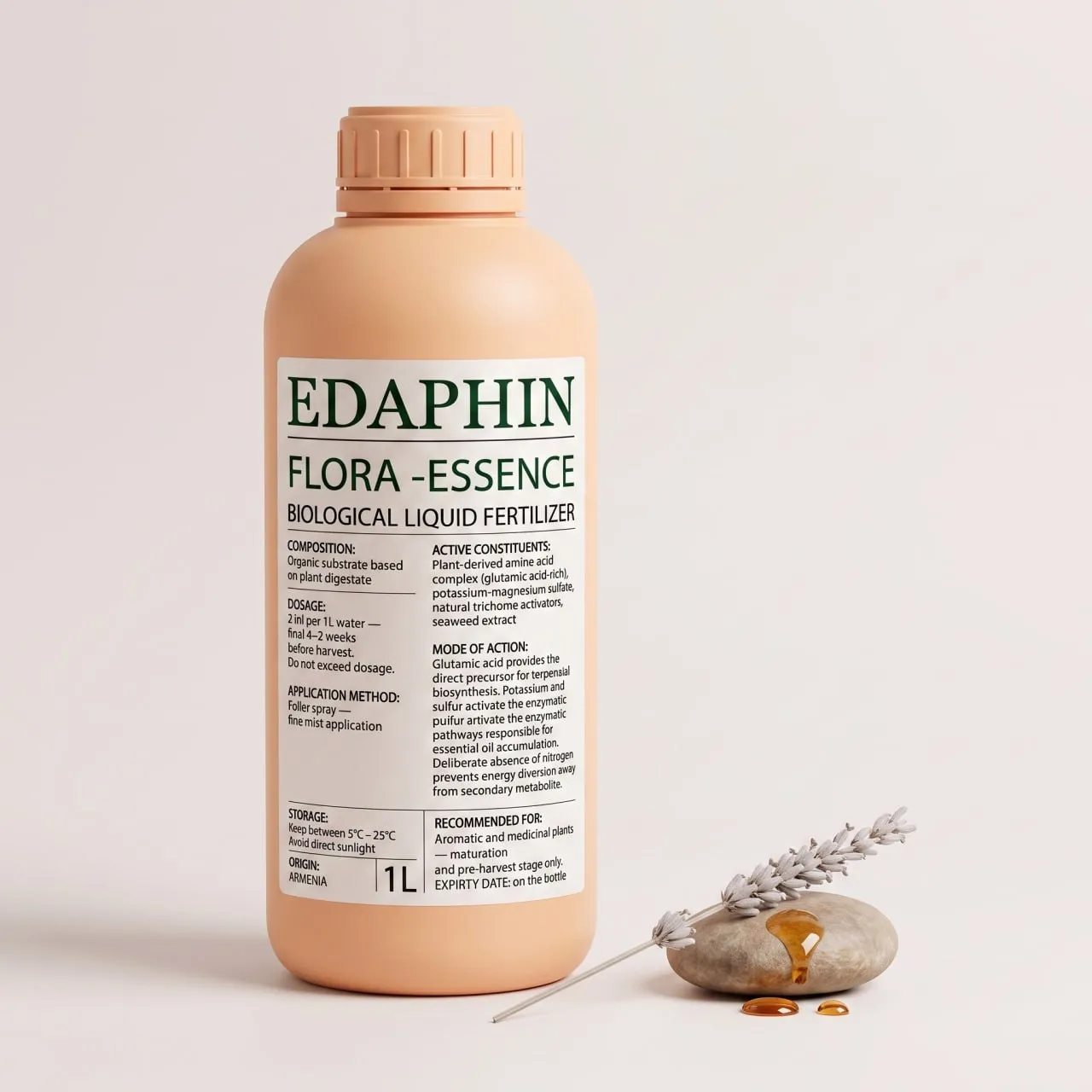
EDAPHIN FLORA — ESSENCE
Maturation and Pre-Harvest — Maximum Secondary Metabolite Concentration
"The last weeks are where quality is decided."
EDAPHIN FLORA ESSENCE is the flagship formulation of the FLORA line — the most specialised, the most technically precise, and the highest-value product in the EDAPHIN range. It is applied exclusively in the final two to four weeks before harvest, when the plant's metabolic priority shifts from producing flowers to concentrating the secondary metabolites within them: essential oils, terpenoids, flavonoids, and aromatic compounds.
The science behind ESSENCE begins with a single biochemical insight: glutamic acid is the direct precursor to terpenoid biosynthesis. Terpenoids — the molecular class that includes virtually all aromatic compounds in essential oils — are synthesised through enzymatic pathways that require glutamic acid as their entry point. The plant-based biological production process that underlies all EDAPHIN products yields exceptionally high concentrations of free glutamic acid in the final product. In ESSENCE, this naturally abundant precursor is concentrated and delivered at the precise stage when the plant's terpenoid synthesis enzymes are most active.
Potassium and magnesium in ESSENCE continue their role from the BLOOM stage, maintaining the enzymatic capacity for terpenoid production through the maturation phase. Potassium-magnesium sulfate provides sulfur — a nutrient directly involved in several secondary metabolite biosynthesis pathways and often overlooked in standard fertilizer programs.
Natural compounds in the advanced ESSENCE formulation activate the jasmonate signalling pathway — the internal signalling cascade that plants use to respond to environmental stress by producing secondary metabolites. By activating this pathway through safe, plant-derived signals rather than environmental stress, ESSENCE causes the plant to increase secondary metabolite production without the yield penalty that actual stress conditions would impose. This is the difference between a plant that produces essential oils because it is struggling and a plant that produces them because it has been given the precise signal to do so.
Nitrogen is absent from ESSENCE by design. Any nitrogen input in the final weeks before harvest redirects plant energy toward vegetative metabolism and dilutes the concentration of secondary metabolites in harvested plant tissue. The nitrogen-free formulation is not a limitation — it is the mechanism.
Recommended For
- Rosa damascena — final 2–3 weeks before rose petal harvest
- Lavender — pre-distillation maturation stage
- Rosemary, sage, thyme — pre-harvest essential oil maximisation
- Chamomile — Matricaria recutita, pre-harvest
- Lemon verbena, lemon balm — aromatic compound concentration
- Any aromatic or medicinal plant — final 2–4 weeks only
Technical Specifications
| NPK Profile | ~0.5 — 1 — 8 |
| Nitrogen | Absent by design — prevents secondary metabolite dilution |
| Key Precursor | Plant-derived glutamic acid — direct terpenoid biosynthesis |
| Sulfur | Present — secondary metabolite pathway cofactor |
| Application Method | Foliar spray — fine mist application |
| Dosage | 2 ml per 1 L water — final 2–4 weeks. Do not exceed dosage |
| Timing | Pre-harvest stage only — not for vegetative or early flowering use |
| Key Outcome | Essential oil yield, terpenoid concentration, aromatic intensity |