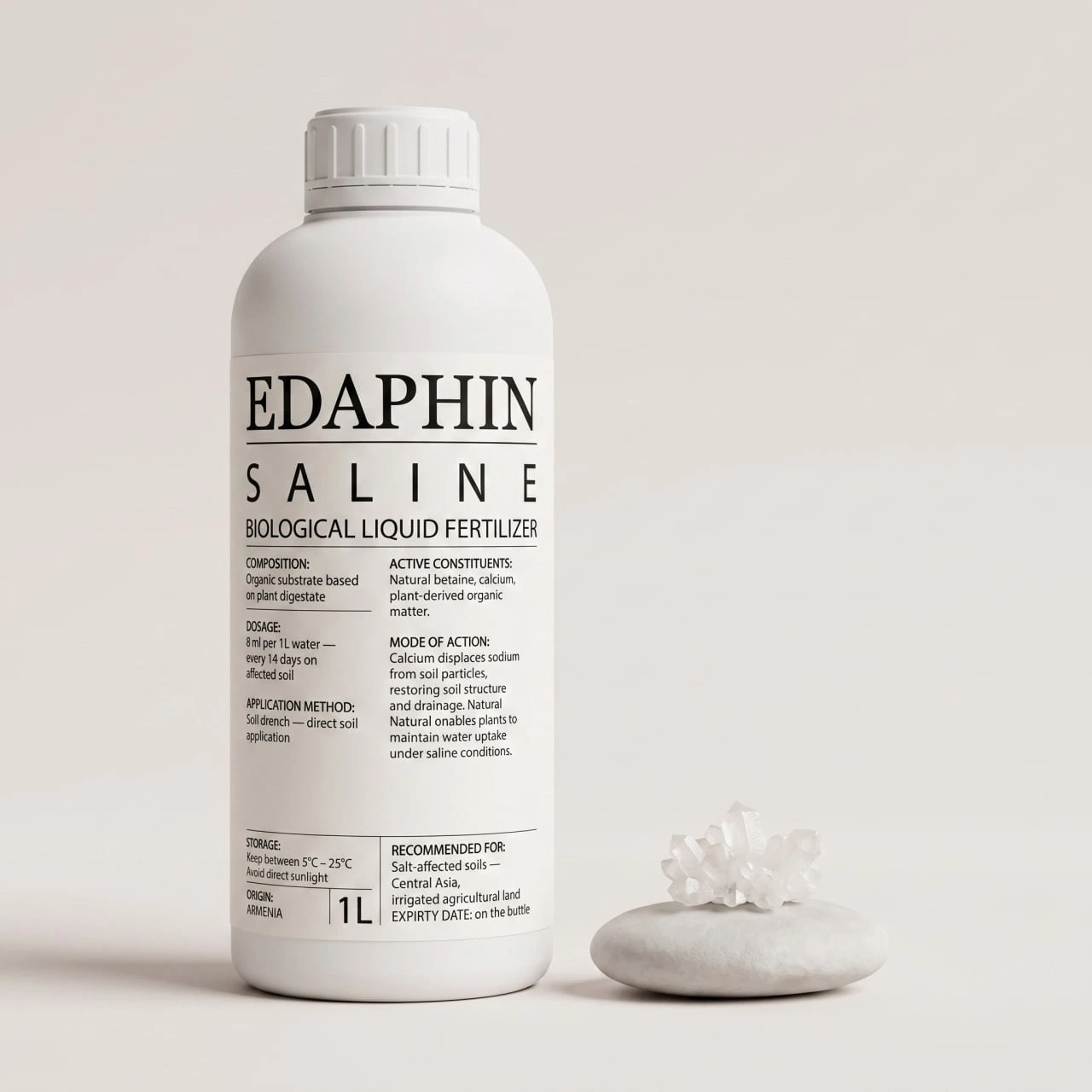
EDAPHIN SALINE
Saline Soil Corrector — Sodium Displacement and Osmotic Support
"Give the soil back what salt has taken."
EDAPHIN SALINE addresses one of the most widespread and persistent problems in irrigated agriculture across Iran, Armenia, and Central Asia: soil salinity. It works through two distinct mechanisms — soil-level sodium displacement and plant-level osmotic support — that together allow crops to sustain production on land that conventional inputs cannot rehabilitate.
Soil salinity damages crops in two ways: it destroys soil structure, and it prevents plant water uptake. SALINE targets both.
At the soil level, calcium ions in SALINE displace sodium from clay particle surfaces. Sodium disperses soil particles and creates a dense, poorly drained structure; calcium flocculates particles and restores aggregation, drainage, and aeration. Displaced sodium moves with irrigation water into deeper soil layers and eventually out of the root zone. This is a physical correction of the soil itself — not a temporary masking of the problem.
At the plant level, natural betaine — present at high concentration in the plant-based biological base — functions as a compatible solute, allowing plant cells to maintain turgor and continue water uptake even when soil solution osmotic pressure is elevated. This is the same principle that halophyte plants use to survive in naturally saline environments.
A critical advantage of EDAPHIN SALINE in saline soil applications is its very low phosphorus content. In soils already containing elevated calcium for sodium displacement, high phosphorus causes calcium-phosphate precipitation — reducing the effectiveness of both inputs. SALINE's low phosphorus design avoids this entirely.
Recommended For
- Salt-affected irrigated agricultural land
- Soils with sodium accumulation from mineral-rich irrigation water
- Rehabilitation programs for degraded saline fields
- Iran — Central plateau and Khuzestan regions
- Armenia and Central Asia — irrigated lowland soils
Technical Specifications
| Mechanism 1 | Calcium-sodium ion exchange — soil structure restoration |
| Mechanism 2 | Betaine osmoprotection — plant water uptake |
| Low Phosphorus | By design — prevents calcium-phosphate precipitation |
| Application Method | Soil drench — direct soil application |
| Dosage | 8 ml per 1 L water — every 14 days on affected soil |
| Phase | Phase 2 product — field trial program active |